
Did you know that the use of AI amongst UK financial advisers has jumped from 43% in 2025 to 74% in 2026? This rapid adoption reflects a fundamental shift in how the industry manages its most critical data. You likely know the frustration of the “month-end clog” all too well: it’s that period where your most talented finance professionals are buried under manual spreadsheet matching, battling the constant risk of human error. This is why automated bank reconciliation has evolved from a simple efficiency tool into a strategic necessity for any growing UK firm.
It’s understandable to feel that manual entry is the only way to maintain total control, but the reality is often the opposite. We promise to show you how to eliminate repetitive data tasks and transform your reconciliation process into a streamlined, AI-driven asset. In this guide, we will explore the practical steps to achieving a faster month-end close, gaining real-time visibility into your cash flow, and building a scalable finance function that grows without the need for additional headcount. Is your current process empowering your team, or is it simply creating friction?
Key Takeaways
- Understand why the 2026 standard for UK finance involves shifting from reactive matching to proactive, high-level financial oversight.
- Discover how machine learning transcends traditional rules to identify sophisticated patterns in vendor behaviour and payment cycles.
- Identify the true cost of the “spreadsheet clog” and why manual processes remain the primary source of friction in modern firms.
- Learn how to implement automated bank reconciliation using a step-by-step roadmap that integrates with your existing Sage, Xero, or QuickBooks stack.
- Explore how flowMEE provides the “Quiet Authority” needed to scale your finance operations and streamline workflows without increasing headcount.
Defining Automated Bank Reconciliation: The 2026 Standard for UK Finance
The definition of financial health has shifted. In previous years, reconciling accounts was a reactive task performed at the end of the month: a process of looking backwards to fix errors. By 2026, automated bank reconciliation has become the real-time pulse of the UK finance function. It’s no longer about simply ticking boxes; it’s about proactive financial oversight. With the completion of the Open Banking “final Roadmap” in late 2024, the infrastructure for secure, standardised data sharing is now a baseline requirement. This allows businesses to move beyond the friction of manual uploads and embrace a state of constant clarity.
Modern finance leaders don’t wait for the month-end close to understand their cash position. They use Bank reconciliation as a strategic tool that operates in the background, synchronising multiple bank feeds across various currencies and jurisdictions. This shift is reflected in the data: as of December 2025, 43.4% of UK Professional and Business Services firms reported using AI to manage their operations. The standard for 2026 requires more than just basic software matching; it demands a system that acts as a safe pair of hands whilst the finance team focuses on growth.
The Core Components of an Automated System
A truly robust system relies on three pillars: connectivity, logic, and oversight. Direct bank feeds are the first essential component. By establishing a secure “source of truth” via FCA-regulated APIs, firms eliminate the need for manual CSV uploads and the errors that come with them. Once the data flows, transaction matching engines take over the mechanics of comparing internal ledgers to external statements. These engines handle the high-volume, repetitive work that previously wasted skilled staff hours. However, the system isn’t designed to replace human judgement. Exception management remains a critical feature, where the platform flags anomalies or complex discrepancies for professional review. This ensures that while the bulk of the work is automated, the user maintains total control over the final figures.
Why “Automated” is No Longer Enough
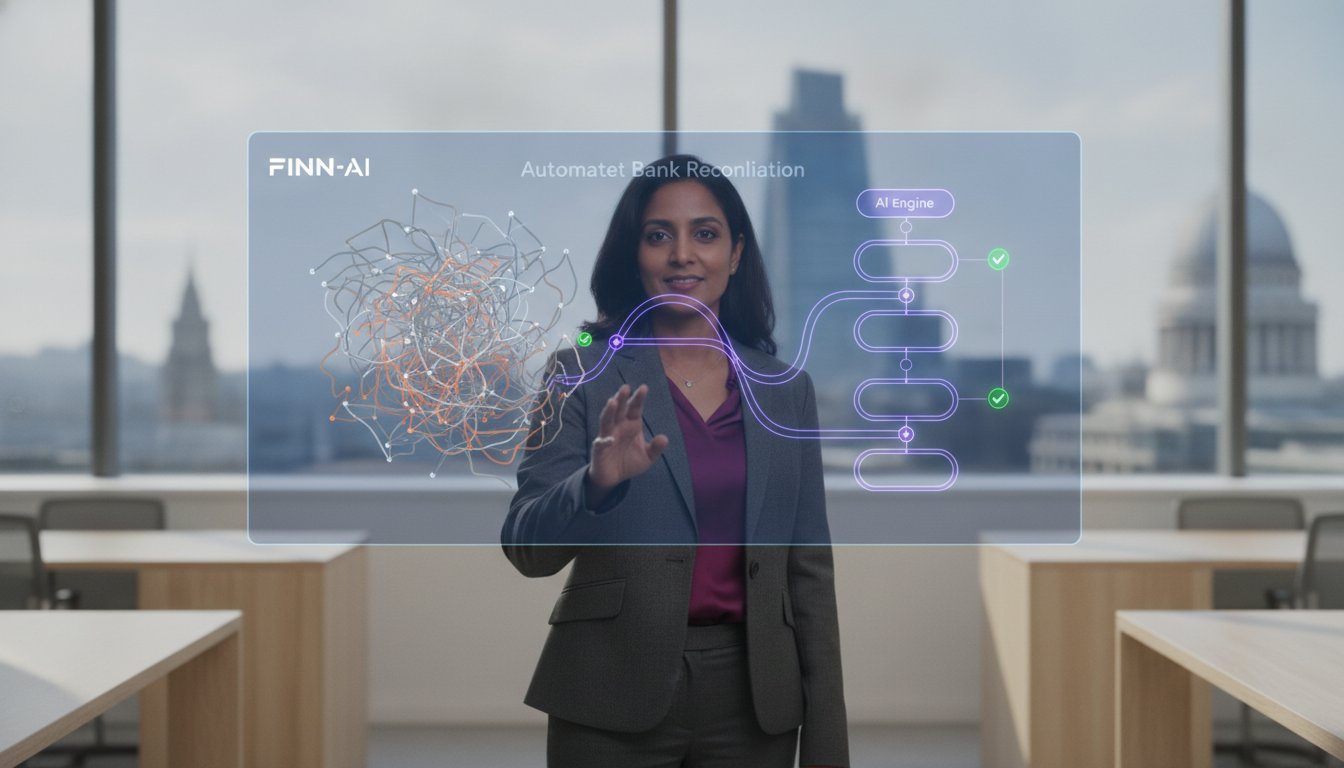
Legacy systems often rely on rigid “if-then” rules that break when vendor behaviour changes or payment cycles fluctuate. In a complex economy, these rules-based approaches create more work than they save. Transitioning to a comprehensive AI accounting strategy allows the system to learn from your specific business context. Instead of just matching identical numbers, the technology understands the intent behind the transaction. This enables “Continuous Reconciliation,” providing real-time cash flow visibility that helps you make informed decisions on a Tuesday morning rather than waiting for a report three weeks later. It’s about moving from a “clogged” state of manual work to a state of free-flowing, automated growth.
Beyond Rules: How AI Transforms Transaction Matching into Strategic Insight
Traditional automation relies on “if-then” logic: a rigid set of rules that works perfectly until it doesn’t. If a supplier changes their trading name or a client splits a payment across two invoices, these legacy systems often fail, leaving your team to manually unpick the mess. Why settle for a system that requires constant babysitting? The transition to machine learning changes the fundamental nature of automated bank reconciliation. Instead of looking for identical strings of data, AI looks for patterns. It recognises that a specific utility provider always bills on the 20th, even if the reference number varies slightly each month. It understands the context of your business, turning a repetitive chore into a source of strategic clarity.
This shift from rules to intelligence provides significant Automated Reconciliation: Benefits & Use Cases that extend far beyond simple time-saving. By identifying granular patterns in vendor behaviour and payment cycles, the system acts as a sophisticated suggestion engine. It doesn’t just flag a mismatch; it offers the most likely solution based on historical data. This effectively clears the “clog” of unresolved entries that typically plagues the month-end close. It’s a free-flowing process where the technology handles the heavy lifting, allowing you to maintain oversight without the drudgery.
Natural Language Commands in Finance
The most significant innovation in 2026 is the removal of technical barriers. You don’t need to be a data scientist or a spreadsheet wizard to manage your workflows. With platforms like flowMEE, you can train your AI accountant using natural language commands. Rather than writing complex formulas, you simply describe how a transaction should be handled. This empowers non-technical staff to manage high-level automation, ensuring that the “Quiet Authority” of the system is accessible to the entire finance team. If you’re looking to bridge the gap between complex data and practical action, exploring how AI-driven reconciliations can simplify your daily operations is a logical next step.
Predictive Reconciliation and Fraud Detection
AI doesn’t just wait for a transaction to occur; it anticipates it. By analysing thousands of entries in real-time, the system identifies discrepancies before they escalate into month-end crises. It’s particularly adept at spotting duplicate invoices or suspicious transaction patterns amongst a sea of legitimate data, acting as a proactive shield for your firm’s resources. AI reconciliation is a self-improving system that gets more accurate with every transaction processed. This continuous learning cycle ensures that your finance function remains scalable and secure, providing a stable foundation for long-term growth.
The Hidden Risks of Manual Reconciliation: Identifying the “Spreadsheet Clog”
Manual processes are often defended as “safe” because they feel familiar. Yet, for many UK finance leaders, this familiarity masks a significant structural risk. The cost of manual reconciliation is far higher than the hours logged on a timesheet; it represents a massive opportunity cost where skilled accountants are reduced to data-entry clerks. Moving to automated bank reconciliation isn’t just about speed; it’s about reclaiming the mental bandwidth of your most valuable assets. When your team is stuck in the “spreadsheet clog,” they aren’t analysing trends or mitigating risks. They’re simply surviving the month-end.
This friction is more than an operational hurdle; it’s a psychological one. Repetitive, low-value tasks are a primary driver of talent attrition in the accounting profession. High-calibre staff want to contribute to strategic growth, not spend their days unpicking “unmanaged” financial data in manual files. Beyond the human element, spreadsheets present a clear danger to security and GDPR compliance. A single misplaced file or an unencrypted attachment can create a governance crisis that no amount of manual checking can resolve. It’s a fragile way to manage the lifeblood of a modern business, and for those who wish to extend this digital clarity to their personal life, you can explore Monthly and Annual Subscription Plans options for the Haevn family hub.
The Scalability Trap
Manual processes possess a fragile ceiling. Industry observations suggest that once transaction volumes increase by as little as 20%, manual workflows begin to fracture under the weight of sheer data volume. This leads to the “hiring paradox”: the belief that you can simply recruit your way out of the mess. In reality, adding more headcount to a manual system often increases communication overhead and error rates rather than solving the core issue. Adopting automated bank reconciliation breaks this cycle. It provides a stable foundation that allows you to scale accounting without hiring, ensuring your finance function remains lean and agile as the business expands.
Audit Trails and Transparency
Proving compliance whilst relying on manual spreadsheets is a daunting task. Auditors require clarity, but a web of interconnected workbooks often provides only confusion. Automated systems replace this opacity with an immutable, transparent audit trail. Every match, every exception, and every adjustment is logged with precision. This addresses the most common objection to automation: the fear of losing control. By using a platform that acts as a “Productivity Partner,” you don’t lose oversight; you enhance it. The AI executes the granular work whilst you maintain the final authority, ensuring that your financial data remains both accurate and beyond reproach.

A Step-by-Step Roadmap to Implementing AI-Driven Reconciliation Workflows
Successful implementation begins with a cold, hard look at your existing friction. Before adopting any technology, you must audit your current “clog” points to identify exactly where the month-end close slows down. Is it the sheer volume of micro-transactions or the complexity of multi-currency matches? Once these are identified, selecting a platform that integrates seamlessly with your existing stack, whether that is Sage, Xero, or QuickBooks, is paramount. A mismatched integration will only create a new type of technical friction that hinders your progress.
In the early stages of automated bank reconciliation, you must define your “Confidence Scores.” This is the threshold at which the AI is permitted to match transactions autonomously. For instance, you might set a 95% confidence requirement for automatic posting, whilst anything lower is flagged for human oversight. We recommend a phased rollout, starting with high-volume, low-complexity bank accounts to build internal trust in the system’s accuracy. This allows for continuous optimisation through regular feedback loops, where the AI learns from every manual correction your team makes. It’s a steady progression towards total financial fluidity.
Integrating with Your ERP
The technical success of your transition relies on bi-directional data flow between your bank and your ledger. For firms using Sage, specific considerations around Sage accounting automation ensure that the AI doesn’t just match entries but also posts them correctly within your existing chart of accounts. Minimising disruption during this transition requires a platform that understands the nuances of UK-specific financial reporting and compliance. If you’re ready to remove the manual burden from your team, you can explore our AI reconciliation solutions to see how these integrations function in real-time.
Training Your AI Accountant
Unlike legacy systems that require complex coding or rigid rules, modern AI is trained through natural language. You simply “explain” your unique business rules to the system as if you were speaking to a new colleague. If a particular vendor always includes a specific reference code that doesn’t match the invoice number, you tell the AI once, and it remembers. Training an AI is a one-time investment that yields perpetual dividends in time saved. This intuitive approach ensures that your automated bank reconciliation remains agile, adapting to new suppliers and changing payment behaviours without the need for constant technical intervention.
Scaling Your Finance Operations with autoMEE’s AI Productivity Platform
True scalability isn’t about adding more desks; it’s about increasing the capacity of your existing team. This is where flowMEE establishes its “Quiet Authority” within your organisation. Unlike intrusive software that requires constant attention, our platform operates with a calm efficiency that replaces the friction of manual labour with modern fluidity. It acts as a comprehensive Productivity Partner, managing the end-to-end lifecycle of financial data. By integrating automated bank reconciliation into a wider ecosystem of AI-driven posting and collections, you create a unified front against financial complexity.
The transition to an AI-led function means moving beyond simple bank matching. Many firms are now looking at Replacing manual reconciliation across every facet of their business: from intercompany transfers to complex document workflows. autoMEE remains committed to providing a secure, UK-compliant environment that respects the traditions of the accounting profession whilst boldly innovating for the future. We ensure your data is grounded in compliance, giving you the confidence to scale without the risk of governance gaps.
A Future-Ready Finance Team
What does a CFO do when they are no longer tethered to a spreadsheet? They lead. By automating the granular tasks that previously caused the “month-end clog,” your senior staff are free to focus on strategic growth and high-level decision-making. This creates a “fluid” finance function: one that responds to market changes with speed and accuracy. In the competitive landscape of 2026, a streamlined back office is no longer a luxury; it is a fundamental advantage that allows your business to grow without a corresponding increase in headcount. Is your team ready to step into this more influential role?
Getting Started with flowMEE
Onboarding with flowMEE is a purposeful and methodical process. During the implementation phase, our team works with you to integrate the platform with your existing Sage, Xero, or QuickBooks stack, ensuring a smooth transition with minimal disruption. You aren’t just buying software; you are investing in a SaaS solution that evolves alongside your business needs. The long-term value of automated bank reconciliation lies in its ability to learn and adapt to your specific workflows over time. Are you prepared to transform your finance department into a strategic asset? We invite you to book a discovery session to see flowMEE in action and experience the future of work today.
The Future of UK Finance: Embracing Strategic Fluidity
The transition from manual data entry to a state of strategic oversight is no longer a futuristic goal; it is the 2026 standard for UK finance leaders. By moving beyond rigid rules and embracing the intelligence of machine learning, your department can finally dissolve the “spreadsheet clog” that hinders growth. Implementing automated bank reconciliation ensures that your finance function remains both secure and scalable, allowing your most talented staff to focus on high-level decision-making. It’s about moving from a state of reactive matching to one of proactive financial leadership.
autoMEE provides the “Quiet Authority” needed to transform your back office into a streamlined asset. Our platform integrates seamlessly with Sage, Xero, and QuickBooks, and is trusted by UK CFOs for secure, GDPR-compliant automation. By reducing manual reconciliation time by up to 80%, we empower your team to operate with a level of calm efficiency that was previously impossible. Are you ready to replace the stress of the month-end close with a free-flowing, AI-driven workflow?
Experience the fluidity of AI: Book your autoMEE discovery session today. The path to a more productive, future-ready finance function starts here.
Frequently Asked Questions
What is the difference between rules-based and AI-driven bank reconciliation?
AI-driven systems utilise machine learning to recognise context and vendor behaviour, whereas rules-based systems rely on rigid, pre-defined logic. Rules often break when transaction details fluctuate slightly, such as a change in a reference number. AI adapts to these changes, ensuring that automated bank reconciliation remains accurate even as payment patterns evolve. It’s the difference between a static filter and a dynamic, learning assistant.
Will automated reconciliation work with my existing Sage or Xero software?
Yes, flowMEE is designed to integrate seamlessly with Sage, Xero, and QuickBooks. It functions as a sophisticated layer above your existing ERP, synchronising data in real-time. This ensures that your ledger and bank feeds remain in constant alignment without requiring you to migrate away from the accounting software your team already knows and trusts.
How long does it take to implement automated bank reconciliation software?
Most firms can begin seeing results within a few days of integration. Whilst the technical setup is rapid, the training phase involves a short period where you explain unique business rules to the AI using natural language commands. This initial investment in time is a one-off process that leads to permanent efficiency gains across your entire finance function.
Is AI-driven reconciliation secure enough for sensitive UK financial data?
Absolutely, safety and governance are at the core of the platform. We utilise secure, GDPR-compliant protocols and leverage the UK’s standardised Open Banking infrastructure. Because the system uses FCA-authorised APIs to access data, your sensitive financial information remains protected by the same security standards used by the UK’s largest financial institutions.
Can automated reconciliation handle credit card statements as well as bank feeds?
Yes, the platform is capable of processing credit card statements alongside standard bank feeds. AI-driven automated bank reconciliation is designed to handle various transaction types, including high-volume card spend and multi-currency accounts. This provides a unified view of your cash flow across all payment methods, eliminating the need for separate manual processes.
Do I still need an accountant if I use AI reconciliation software?
Yes, your accountant is more important than ever. The AI is a productivity partner designed to handle repetitive data entry, not to replace professional judgement. By removing the drudgery of matching thousands of entries, your accountant can transition into a strategic role, focusing on high-level analysis and business growth rather than basic bookkeeping.
What happens if the AI makes a mistake during the matching process?
The system is built with human-centric control as a priority. If the AI encounters a transaction with a low “Confidence Score,” it won’t post the entry automatically. Instead, it flags the item for human review and presents an intelligent suggestion. Once you provide the correct match, the system learns from your decision, ensuring it handles similar cases correctly in the future.
How much time can my finance team expect to save each month?
Many finance teams report a reduction in manual reconciliation time of up to 80%. This significant efficiency gain allows your staff to reclaim days of work each month that were previously lost to the “spreadsheet clog.” It transforms the month-end from a period of high-stress survival into a streamlined, calm process of final verification.